
Considering Union Representation? Look at the Results
You may wonder: Can a union truly deliver on its promises? Fortunately, you don’t have to guess—you can look at what the union actually achieved for employees in crisis and withdrawal management. In November 2025, the union and Clinica finalized a collective bargaining agreement (CBA) after 15 bargaining sessions over 18 months. Both sides made concessions, but here are the key terms of that agreement:
| Article | Summary |
|---|---|
|
Annual Raises |
2.5% per year for three years. Please click here to look at this explanation of a dollars and cents breakdown of what this increase looks for an hourly employee. |
|
Union Dues |
SEIU currently sets dues at 2.25% of your pay. At 2.25% of your pay, the effective raise in year one is only 0.25%. For an employee earning $20/hour, that amounts to an additional five cents an hour. Importantly – the dues amount is completely controlled by the Union. Dues rates are not negotiated with Clinica, and are subject to change unilaterally by the Union. |
|
Reduced Hours |
Most employees will move from a 1.0 FTE to a 0.9 FTE—meaning fewer scheduled hours each week |
|
New Time-Keeping Requirements |
Employees must now clock in and out for lunch breaks |
|
Seniority Rules |
Important parts of employment like Vacation, scheduling and layoff decisions are now based on seniority—not skills or performance |
|
Benefits |
Employees receive the same health and welfare benefits on the same terms as non-union employees |
|
Clinica still makes staffing and scheduling decisions |
Clinica still has the right to set staffing levels and working hour |
After over a year of negotiations, these are the ACTUAL results. Before deciding whether union representation is right for you, consider whether this outcome matches the promises made during the union’s campaign.
Collective Bargaining 101
Collective bargaining is a negotiation between a union and an employer to decide wages, schedules, and other terms and conditions of employment. The union may promise wage increases and other improvements to get employees to vote for the union. However, the law makes it clear, that as a result of negotiations, you could end up with more, the same or less than what you currently have here at Clinica. Employees’ wages, schedules and other terms and conditions of employment would be subject to the negotiation process.
Here are some facts about collective bargaining:
- First contract negotiations often take a long time. Bloomberg Law issued a report stating the average first contract in the private sector takes over 465 days to negotiate. While this is an average number, we simply don’t know how long it will take; nor does SEIU.
- The parties are required to negotiate “in good faith.” This means that both parties must meet at reasonable times and exchange proposals. Federal law allows both sides to simply say “no” to the other’s proposals. There is no requirement that the parties ever reach a contract.
- If the parties reach an agreement, there is no guarantee that employees will end up with better wages, benefits, or terms/conditions of employment than they had prior to unionization. Union representation just means “representation” – not necessarily good or bad representation.
Union contracts routinely put seniority over performance, with one-size-fits-all policies that could change scheduling flexibility and your ability to get shifts that meet your needs. The typical collective bargaining agreement adopts a one-size-fits-all philosophy and rigid rules that allow SEIU to control most aspects of your work life like scheduling, transfers, time off, promotions, and FTE hours.
Unions often make lots of promises to employees about what they might be able to get for coworkers at the bargaining table. SEIU cannot guarantee that any specific benefit or aspect of your employment with Clinica will change for the better.
| Article | Summary |
|---|---|
|
Article 1 |
|
|
Article 2 – Non-Discrimination |
|
|
Article 3 – Definitions |
|
|
Article 4 – Union Representation |
|
|
Article 5 – Scheduling |
|
|
Article 6 – Discipline |
|
|
Article 7 – Grievance and arbitration |
|
|
Article 8 – Seniority |
|
|
Article 9 – Job Postings |
|
|
Article 10 – Job security |
|
|
Article 11 – PTO |
|
|
Article 12 – Health and Safety |
|
|
Article 13 Committees |
|
|
Article 14 – Job Security |
|
|
Article 15 – Education and training |
|
|
Article 16 – Benefits |
|
|
Article 17 – Mileage and Property |
|
|
Article 18 – Wages
And Appendix A – Wage table |
|
|
Article 19 – Duration |
|
|
Article 20 – No strike/no lockout |
|
|
Article 21 – Management Rights |
|
A bargaining Unit of Crisis and Withdrawal Management Employees at the Valmont Facility
The Union won its election to represent the bargaining unit in May 2024 but did not request to begin negotiations until the fall. The first bargaining session was held in late January 2025. Since then, Clinica and the Union have met in person for 12 bargaining sessions, along with one brief virtual meeting. Of the proposals agreed to, employees in the new bargaining unit WILL need to pay dues as a condition of keeping their jobs. The Union proposed a security clause on January 23, 2025.
Typically, sessions begin with one party—often Clinica—presenting counterproposals to existing items. These proposals are reviewed and explained, followed by caucuses where each side evaluates and revises their positions.
This link will be updated as bargaining continues. To date, so far the parties have tentatively agreed to articles in the future contract to include Union Security, Seniority, and Management Rights, among others.
Union Security and Seniority Clauses Proposed by SEIU Local 105
A union like SEIU is a large, complex organization with enormous overhead costs and financial commitments to other labor groups, community groups, and political allies. This is why unions often insist on security clauses in CBAs. Local 105 and expenses are detailed in their federal filings.
Union Security and Seniority Broken Down
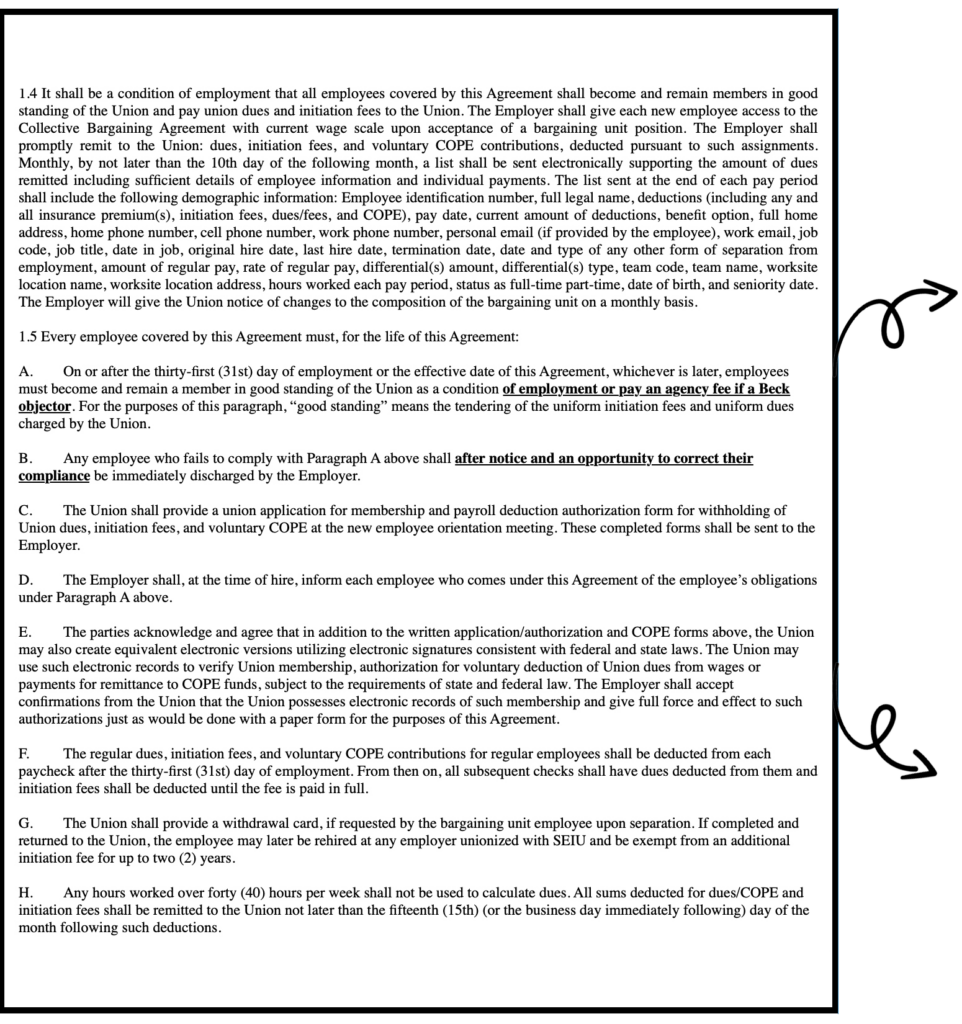

Security Clause – Proposed by the Union and Modified by the Employer
A. It shall be a condition of employment that all employees covered by this Agreement and those hired on or after its effective date shall, within thirty-one (31) days following the beginning of such employment become and remain members of the Union or tender to the Union a fee equal to the initiation fees and periodic dues that are the obligations of members.
Beck Objector – The Union initially proposed that all employees must be members in good standing to retain their jobs. Clinica insisted on revising this language to protect employees’ rights under Beck v. Communications Workers of America, a Supreme Court decision affirming that employees cannot be required to become full union members. “Beck objectors” are still obligated to pay significant fees to the Union, but not the full dues amount.
Section 1.5.B – The Union originally sought contract language requiring immediate termination for employees who missed a dues payment. Clinica advocated for a more balanced approach, successfully requiring that employees receive notice and an opportunity to cure noncompliance before the Union can require termination.
Union proposed Seniority Clause and Management edits
From the outset of negotiations, the Union has consistently proposed that seniority be the primary factor in decisions related to promotions, scheduling, layoffs, reorganizations, leave policies, leave accrual, and other employment benefits.
You may have heard from the Union you won’t have to pay dues or seniority won’t play a factor in the CBA. These are articles that have been proposed by the Union and countered by Management.
Some Frequently Asked Questions about Collective Bargaining:
Can the union guarantee that it will get us everything it says it will? Can it guarantee any of the things its promising?
No. The union cannot guarantee that any of its promises will come true. Indeed, if the union were to be voted in it would then engage in collective bargaining with CFHW to achieve a collective bargaining agreement. Under the law, during collective bargaining, neither party is required to agree to any proposal set forth by the other party so there are no guarantees.
Clinica agreed to a CBA that set a minimum wage for all employees, regardless of experience. Wouldn’t that approach work here?
Each CBA negotiation is unique. The CBA for the other unit primarily covered employees that were already paid the same rate under legacy MHP rules. A different group of employees with different experience, skills and qualifications could lead to a different outcome in bargaining. It is also possible that if a flat rate is proposed, some employees may actually lose money in bargaining. Bargaining is a gamble – things could go up, down, or stay the same.
The union is saying they can make CFHW institute specific staffing levels. Is that true?
While a union may try to negotiate certain staffing levels into the contract, CFHW does not have an obligation to agree to any such proposal (absent state law regarding staffing ratios). Even if this type of provision is negotiated into an agreement, many agreements with these types of provisions also have options for management to change those provisions if necessary for patient care and emergencies, meaning the ratios can be exceeded if necessary. If that were to happen, a union’s recourse for violation of such a provision is with the grievance and arbitration procedure, which can take months and may not provide relief in the moment.
If a union wins an election, would CFHW automatically have to sign a contract with the union?
No. If the union is voted in, CFHW and the union would engage in the collective bargaining process to negotiate the terms and conditions of employment for all employees in the bargaining unit. There is no law that forces either party to agree with the views and demands of the other party. As a result, the collective bargaining process can take months or years.
What types of issues are subject to negotiation?
Most terms and conditions of employment are subject to collective bargaining. This would likely include the following: wages, health benefits, retirement benefits, seniority, PTO, holidays, scheduling, shift differentials, overtime (including potentially mandatory overtime), incentive pay, shared governance, floating, layoffs, discipline, and the process for bringing a grievance, among others. There are topics under the law known as “mandatory” – where if any party raises them, the topic must be negotiated. These include a wide range of topics. There are other topics of bargaining, known as “permissive” that either party can raise to be bargained, but the other side does not have to agree to bargain. This includes topics like changes to recognition clauses.
Will I get more money if the union is voted in?
That’s likely what the union wants you to think but the answer is no, not automatically. All the union can do is ask, and Clinica say “no” to wages or benefits proposed that it does not agree to. And Clinica would not likely agree to anything that does not make sense for its business, its employees and its patients.
Can wages and benefits be reduced as a result of collective bargaining?
Yes. In collective bargaining negotiations, the wages and benefits that you currently enjoy could be lost or traded for something else. In collective bargaining, things could go up, down, or stay the same. Bargaining is a give and take process where you might have to give up something you have in order to get something else you may want. The hazards of collective bargaining are well recognized in case law from the NLRB, federal and state courts.
Is it worth paying union dues because Clinica must agree to the union's demands in collective bargaining?
No, Clinica does not have to agree to any demand that it believes is not good for business, or might be harmful to Clinica or its patients. The law does not require the employer to agree to a single union demand, and vice versa. Paying the union dues doesn’t guarantee any outcome.
Do I still have to pay dues if I am not satisfied with the contract terms?
Yes. You could be obligated to pay dues or fees, regardless of whether you are happy with what is in the contract or not or you are unhappy with the union representatives or services. In other words, there is no “opting out” – as an employee in the bargaining unit, you would have to live under the terms of the contract negotiated by the bargaining committee and Clinica – regardless of whether you are satisfied with the contract.
The union showed me a contract from another health care provider and told me that we will have the same contract or better at Clinica, is that true?
No. The union cannot guarantee any result In collective bargaining, Clinica can say “no”. Every negotiation is different. What another company may have agreed to with a union has nothing to do with Clinica. In collective bargaining, Clinica can say to any proposal it disagrees with, regardless of whether some other employer somewhere else agreed.
How long would it take SEIU and Clinica to negotiate a contract?
There is no timetable. Negotiations can take many months and sometimes even years before the parties reach either an agreement or an impasse (a legal deadlock). Sometimes, even after lengthy bargaining, unions and employers do not come to an agreement.